
Table of Contents
JOY/EASE Worksheet
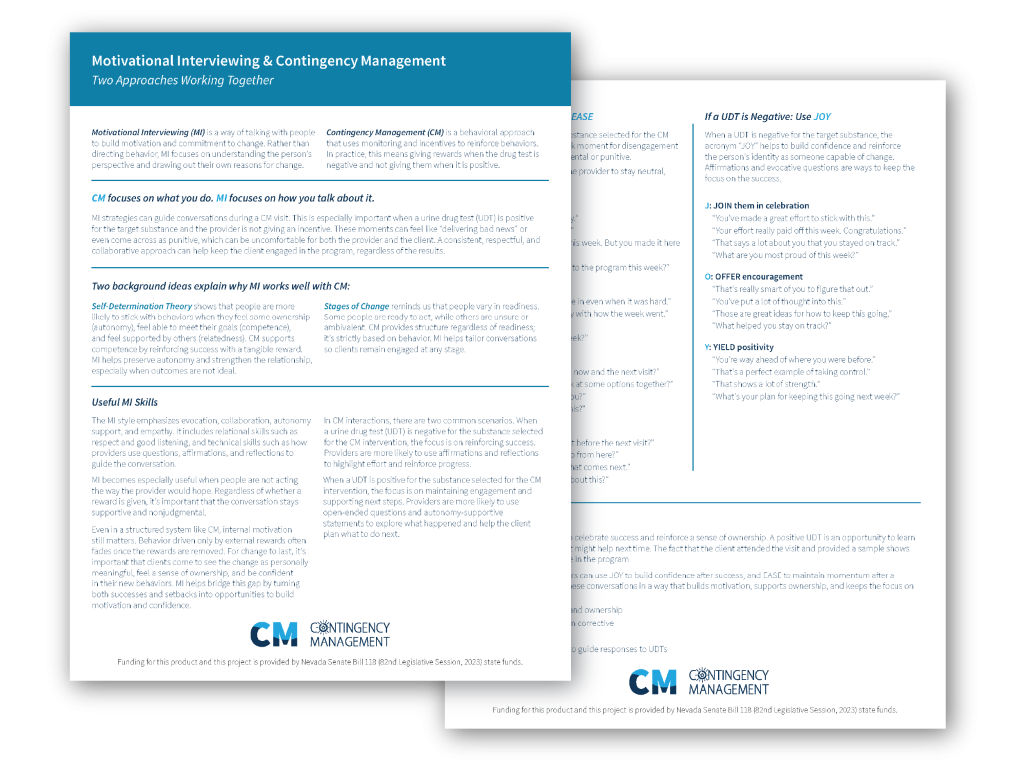
This fact sheet gives a practical overview of how motivational interviewing (MI) can support the delivery of contingency management (CM) interventions. It shows ways to reinforce success, respond to setbacks, and maintain client engagement over time.
Motivational Interviewing (MI) Summary Fact Sheet
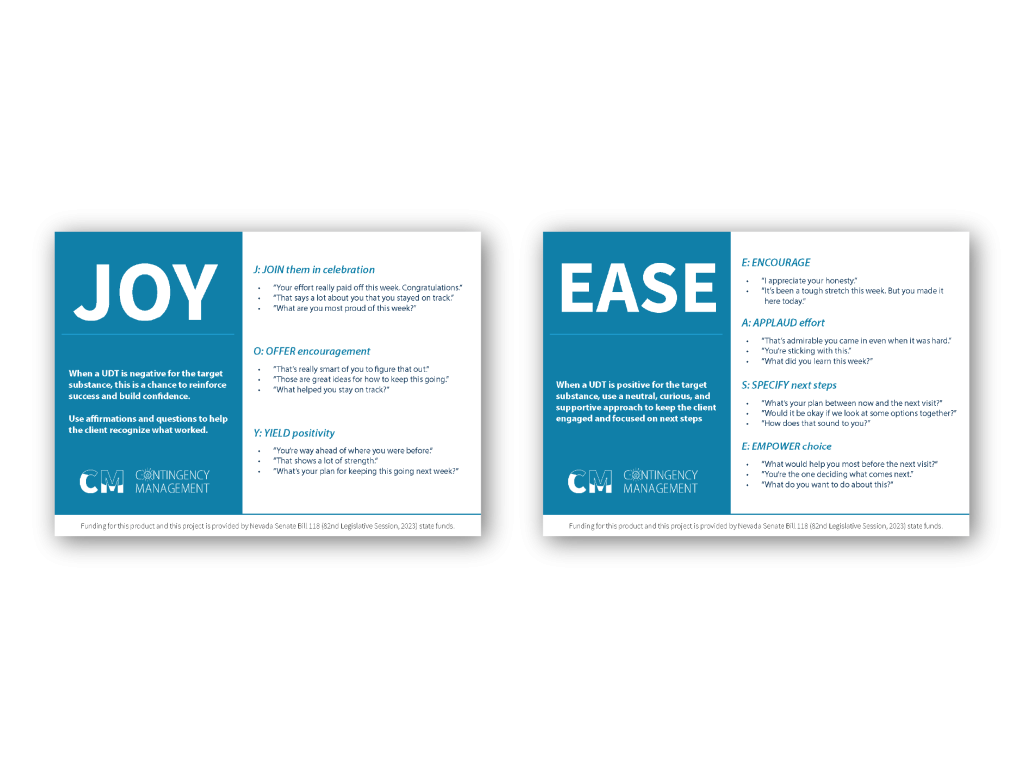
These tip sheets give simple, MI-consistent steps and language for responding to negative and positive urine drug tests during CM visits.
Contingency Management Overview Training
This webinar shows how Motivational Interviewing (MI) can be used to support the delivery of Contingency Management (CM) interventions. While CM provides structure through monitoring and incentives, MI shapes how these interactions are communicated—especially when clients
are not meeting targets. Participants will learn how to use core MI skills during CM visits to reinforce success, respond to setbacks, and maintain engagement. The session includes brief activities and examples, including the JOY and EASE frameworks to guide conversations.
By the end of this webinar, participants will be able to:
- Describe the role of MI in CM: Explain how MI supports the delivery of CM interventions.
- Use core MI skills in CM visits: Apply basic MI strategies (e.g., open questions, affirmations, reflections) to support engagement.
- Apply JOY and EASE in practice: Use JOY to reinforce success and EASE to respond to setbacks during CM interactions.
Continuing Education Units: 1.5 CEU // This series offers up to 1.5 contact hours and is approved for professionals licensed by the Nevada Board of Examiners for Alcohol, Drug and Gambling Counselors, the Nevada Board of Examiners for Marriage and Family Therapists and Clinical Professional Counselors, and the Nevada Board of Examiners for Social Workers. No credit awarded for partial or non-attendance.
Cost: FREE
Presented by: Scott Walters, Ph.D.
Motivational Interviewing in Coningency Managment Webinar
Contingency management (CM) is one of the only evidence-based behavioral interventions shown to be effective in treating stimulant use disorder (StimUD). Contingency management provides monetary incentives (such as gift cards) for meeting treatment specific goals, including stimulant non-use as measured by point-of-care urine drug tests (UDTs). Through the systematic application of positive reinforcement, individuals are rewarded for positively changing stimulant-focused behavior. Substance use offers a powerful, immediate reinforcement. Contingency management confronts this challenge by offering immediate financial awards that can help activate the brain’s reward system, thus encouraging the replacement of stimulants with the non-drug incentive to achieve a dopamine release. This two-hour training workshop is designed to provide a broad overview of contingency management as a behavioral intervention for the treatment of StimUD.
The topics presented throughout the workshop include:
- the scope of stimulant use in Southern Nevada and beyond;
- effects of stimulants on the brain, body, and behavior;
- the psychological and behavioral principles of CM;
- four essential ingredients of a protocol-based CM Program;
- positive, encouraging elements of CM;
- the research support for CM; and
- strategies for planning for, financing, and implementing a structured CM Program.
By the end of this webinar, participants will be able to:
- Describe at least three (3) patterns and trends regarding the scope of stimulant use in Southern Nevada and beyond.
- Identify at least three (3) acute and three (3) chronic effects of psychostimulant drugs on the brain.
- Specify at least three (3) key principles of operant conditioning.
- Formulate a list of the four (4) essential elements of an evidence-based protocol-driven Contingency Management Program to address stimulant use.